Positive Parenting: Free Online Parenting support!

This information was emailed to me by my kid’s school district.

The Santee School District and Jewish Family Services are presenting the Positive Parenting Program via Zoom.

Dates: Wednesdays: 10/9, 10/16 & 10/26, 2024
Time: 6-7:30pm (Register in advance)
Register Here

California Residents: Free Behavioral Health Coaching for Kids 0-12

Brightlife is a great, free resource for California families. They offer free behavior coaching for parents of children ages 0-12 years.

Kids ages 0–12 get free, expert coaching for sleep issues, worry, social skills, and more. Live, 1:1 video sessions, secure chat, on-demand content, and more.

Brightlife Kids is fully paid for by the State of California. Together, we are working to ensure all California families can find the behavioral health support they need when they need it. You qualify if you have a California zip code and a child ages 0–12.

Check out their website for more information and to see if Brightlife is a good fit for your family.

Why I Gave Up Hustle Culture and Got a Full Time Job

For years, I was part of the hustle culture. I did gigs and what most people deemed to be “side work” so that I could stay home and support my kids in their education and development. Hell, I even have a page dedicated to it on this blog. 

And I did a post about the Side Hustles seen frequently on Tik Tok too. The research time it took for that was about 6 months, and it was awful. The return on investment (ROI) was not there.

Childcare here in Southern California (and the entire US) is costly and I wouldn’t be able to work full-time and bring home enough money to contribute to the family, beyond paying for daycare. Once we discovered Bubs was on the spectrum, my work outside the house was thrown out the window. There were a lot of appointments, therapies, and special help that were required. So I hustled- I spent hours each day doing surveys online, research studies online and in person, product reviews, teaching coupon classes, and doing app-based work for Field Agent and other similar apps (mostly secret shops and store/product placement audits). And of course, blogging and posting deals and affiliate links when I could make it work and not sound like I was shilling for some company. Because I have a small following, I didn’t have access to a lot of opportunities and sponsorships, in fact, after the pandemic, a lot of programs and companies changed their content creator programs to only larger (10k+ followers) audiences, leaving us little guys out. That meant, once again, it was back to the drawing board, finding new ways to make the same amount of money as before.

My original plan was to go to still blog Part-Time, as well as work Part-Time outside the home after the littlest was in school and work during school hours, however, COVID happened and plans were changed. In late 2021, I started looking for a small, part-time job, and I found one at a local school, in the district where my kids attend. It was a few hours a day, and it was a great way to ease back into working outside the house.

This fall I was offered an opportunity to become a paraeducator, assisting in a special education classroom. After discussing it with my family, and making sure there would be coverage from school pick-ups, I applied for and accepted the job. I work while my kids are at school, and I pick them up from my mom’s house right after school/work, and we have enough time for whatever appointments and shenanigans each afternoon. I have the same weekends and holidays off that they do, and I can work summer school for 6-ish weeks if I want to.

Why am I telling you all of this? The rise in popularity of hustle culture has made it harder for most of us to rely on it to get along. There is the same number of opportunities, but more of us trying to get by and scramble for all of those gigs. If you find yourself struggling with gig work and you have a set schedule that you need to abide by (for example, if you have school-age kids that you are responsible for dropping off and picking up each day), think about working jobs that support kids.

Many school districts are hiring kitchen and cafeteria workers, lunch and playground aides, and even paraprofessionals. There are few prerequisites for these jobs, and a lot of the training and guidance you get on the job. Full-time in most districts is only 30 hours a week, and full-time work comes with benefits. Most districts use EdJoin for job postings, and there are postings from teaching to classified staff. And if you aren’t available every day, you can join the substitute pool (even for classified jobs, like mine), and work per diem as you are needed.

Working in a public school isn’t going to make me rich, but the steady salary helps my family, and the consistent schedule is helpful for making appointments and doctor’s care.

Bottom line- I was tired of busting my ass to make pennies. I spent most of my 30’s working every day, trying to juggle motherhood and making money, trying to give my kids awesome experiences and fun every day while doing surveys from my phone at the park, staying up late to write reviews (a 500-word review about tampons? Come on!), and I was making less than minimum wage, but I had “Time Freedom” and I was “Able to Work Where Ever I Wanted!” and all of the other lies that hustle culture has fed us (Not to mention MLM culture, but I’ll leave that to Roberta Blevins). Now I’m happier and healthier, and I feel like I’m a better mom because I’m able to worry less about making the ends meet, and I can spend time playing with legos with the kids without having to stop every 5 minutes to post something or pack us all up to go do a secret shop or audit.

That being said, one of the few things I still do that’s posted on my Side Hustle page is Small Business Knowledge Center. It’s easy, quick, and I get paid for sending them my junk mail. It’s free Starbucks/Pizza money (Kid’s choice).

Homeschooling Parents: San Diego Gameschooling Expo 8/19/22!

The Stronghold is excited to present its very first San Diego Gameschooling Expo!

  • Friday, August 19, 2022
  • 10AM-2PM

Venues:

  • The Stronghold:Check-In and Primary Gaming Area for Ages 6+
  • The Dancehouse: Teen Gaming Area (Ages 13+ only)
  • Yeeha Boba: Trivia
  • Point Loma Library: Parent Conference and Vendor Fair

What’s the Expo about?

Bringing together families for a fun, interactive Gameschooling mini convention accompanied by homeschooling vendors throughout San Diego! Join them for the Parent Conference, Gameschooling activities, Vendor Fair, Prizes, and more!

What’s the cost to attend?

Adults are FREE! Kids Ages 6-12 are $15, and Teens (13 and up) are $20 a ticket. Interested in volunteering to get a free ticket for your kids? They have limited opportunities to waive up to one registration per adult.

What does the ticket include?

Ticket includes access to our Parent Conference, THREE of the Gaming Areas, including the following but not limited to Board Games, Chess, Puzzles, and Trivia. Please note they will not be having Video Gaming at this event.

To learn more about this event and secure tickets, visit their Eventbrite page here


Managing a Household with Neurodivergencies (ADHD, ASD, etc.)

Earlier this week my friend Sam posted on Facebook, “Neurodivergent Friends what are some tools you use with others that help you with daily life, communication, relationships?”

A few friends posted that they needed help with meal prep, day-to-day stuff, and as y’all know, that’s my bag, baby!

Both my kids are Neurodivergent (ADHD/ASD and ADHD), and their dad has ADHD (combined type/ C) and because of that, we’ve had to make some adjustments to our daily life and how we function. And while our processes and schedules may not work for everyone, hopefully, these tips give you some idea and hope if you need it.

Some of these directly affect/benefit the kids, and some make my life easier, which in turn makes their lives easier.

Having an accurate(ish) pantry, fridge, and freezer inventory. I have made my own sheets in the past (using Canva), but the ones from Organized Home are great.

Meal Prep and meal planning (this includes using Dream Dinners once every few months). This frees up time each night to read, hang out, bathe, and get kids ready for bed.

Meal Prep can be as easy as cut up veggies, fruit, pre-portioned foods, and easy meals or side dishes prepared in advance that only need to be heated up to avoid wasting money eating out because “there is nothing to eat”. Also having one night for take-out. And I have a whiteboard that lists our meal plan for the week- I try and post it weekly on Instagram.

The Snack Box- I also organized our fridge and pantry to be more ND-friendly. Stuff that should be eaten (healthy food like fruit, cheese sticks, yogurt, etc.) is at kid eye level in clear packaging and is labeled (I use expo markers on my Rubbermaid containers), and I have a “Snack box” in the pantry that is available 24/7 for hungry faces. It’s got individually portioned shelf-stable snacks and meal components. And on days when I am too tired/rushed to cook we have “Meal of snacks” where I serve a variety of snacks on old-school sectioned cafeteria trays- fruits, veggies, crackers, cheese, cookies, and a drink (juice or iced tea is a hit).

We have a list of snacks on the fridge so the kids know what there is to snack on. It is a visual list (I drew it), and when we are out of specific items, I cover the picture with a piece of posit note.

Calendars– in the kitchen, and one in each bedroom. I update them weekly, plus the grownups use the calendars on their phones and we have a shared family calendar. Kids get reminders each day in the morning and afternoon of any appointments or events that will take place during the day. The visual and auditory reminders really help cement the appointment in their mind.

Visual reminders– next to the front door at eye level there is a sign that reminds us we need: cellphone, wallet, keys, and garage door opener. It’s laminated.

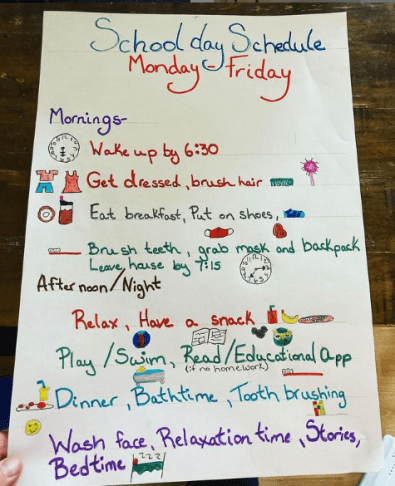
Visual schedule– this is mainly for the kids. I drew up a daily schedule using words and pictures. I wrote a post about it here.

Lists– Everyone has a “Care tasks” list each week that includes appts, returning borrowed items, and tasks to do throughout the week. You can read about my weekly Care Tasks here. 

Larger font digital clock with day of the week, date, and what part of the day (morning, afternoon, evening, night). The kids can read a clock, but it can take time to engage their brains and count by 5’s, but the “old people clock” as it was marketed on Amazon helps them instantly and helps a lot with the “is it time for xxxxx yet?!?!”

Using your phone to stay on top of details- I saw this on Facebook in a group and I’ve started doing this. If you have an iPhone, there is a notes section in each contact. I’ve seen them used to keep track of favorite fast food at various restaurants, favorite foods/drinks, clothing sizes and brands, favorite colors, birthdays, and anniversaries. It’s such a game changer.

The fidget/stim box– we have a plastic box full of fidget/stim toys for everyone to grab when they need to focus. And everyone has some in their room too. This includes headphones to cut down on loud sounds (I buy the landscapers kind from harbor freight). We have 3 pairs in the house and two pairs in the car. For those not familiar- fidget toys can help calm the body so the mind can focus.

Some favorites include pop-its, hand strengthening eggs, fidget cubes, fidget spinners, stretchy tubes, pop tubes, and stress balls (the kind with Orbeez are super satisfying). Amazon sells really great fidget toys mutli-packs.

Medication Boxes- We refill our medication boxes each week (both AM and PM).  The three of us take our meds together each morning at breakfast time. Our medication boxes live on the kitchen counter, along with our pill minders: Jon Cena and Skeletor.

Stuff has a place– The kid’s shoes and backpacks are always by the door during the school year, ready to be cleaned out and refilled each night. My car keys and purse live in the same spot, the pool key has a special spot. The extra toilet paper and paper towels are always in the same spot (under the front bathroom sink). These are just a few examples of the ways that we remind ourselves and create routines. Creating routines can give us a sense of normalcy and be calming.

The Family Binder– One last thing that doesn’t directly “help” the kids but helps the family, especially in times of emergency is the family binder. I’ve had one since 2010 in various incarnations. I have a really old post about it here.  It’s basically my brain in paper form. It’s got all of our important papers, insurance info, important phone numbers, policy numbers, warranty information, receipts for expensive/valuable stuff, copies of most recent IEPS, copies of diagnosis paperwork, lists of everyone’s meds, doctors info, etc. Think of it as all the info you’d need if you lost power for an extended period, your house burned down, or there was a tornado.

There are a lot of other things that we do in our home to help the kids- keep them safe, regulated, and happy. The stuff listed above is just a small sample. Everyone’s home runs differently. And this was and continues to be a lot of work. The examples above are continually changing, and evolving in our home, and are a combination of 11+ years of hard work, learning, and failing. Some of this stuff I did to try and get organized in my late 20s, even before I was married and had kids.



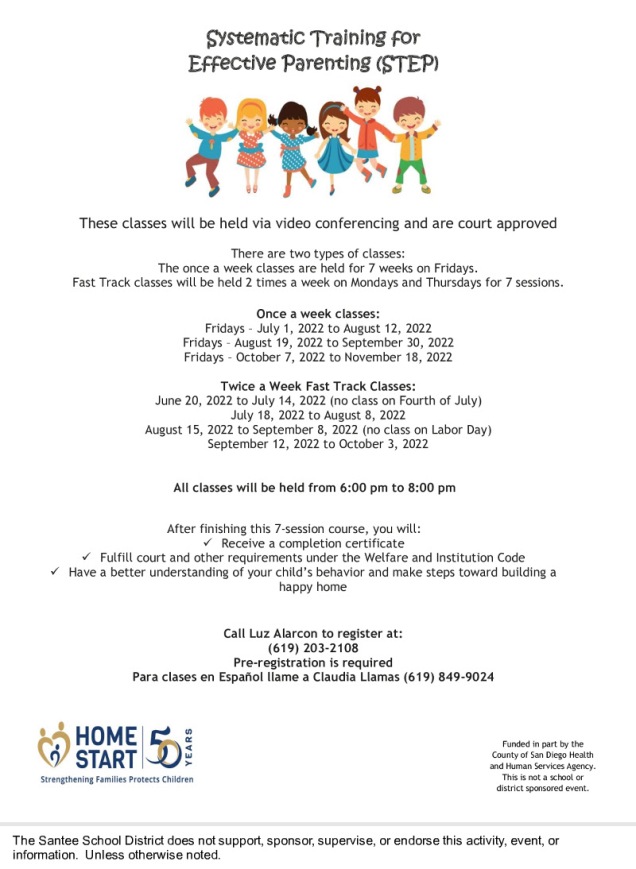
2022 Free Parenting Classes (Online)

I got information about this class in my inbox from our local school district. This class is free and is all online.

Systematic Training for Effective Parenting (STEP) Classes.


I’ve never taken this class, but it looks like a great opportunity. After Finishing this 7-session course, you will:

  • Receive a Completion Certificate
  • Fulfill court and other requirements under the Welfare and Institution Code
  • Have a Better understanding of your child’s behavior and make steps toward building a happy home.

To sign up or if you have questions, contact Luz Alarcon at 619-203-2108. Pre-registration for this class is required.

Special Needs Family Resources and Fun in San Diego March/April 2022!

I received this from one of the specialists at my kids’ school and thought I’d share. There are so many great events and opportunities coming up for families with special needs kiddos here in San Diego!

  • UCSD is hosting a free virtual Autism Resource Webinar. This Webinar will cover sleep disturbances in Autism and strategies that may help! Zoom webinar will be held on March10th from 4:00-4:30.
  • FREE accessibility mornings at the New Children’s Museum. Museum will open an hour early to provide a sensory-friendly experience in a quieter setting. March 12th from 8-9 am. You are welcome to stay for the day as well!
  • San Diego Padres Behind the Scenes Event. Padres is partnering with the Autism Society of San Diego, on March 13th from 11am-2pm. Families will get a guided tour through the ballpark!
  • RACE FOR AUTISM 5K! celebrate autism awareness with either a 5k or a 1-mile family fun walk throughout balboa park. April 2nd, 5k begins at 7:25 and then 1 mile run at 8:30. register at raceforautism.org.
  • Autism Accessibility Mornings at the Fleet Museum. Families will benefit from a low sensory experience and can enjoy the exhibit galleries in a quieter setting and a special IMAX film screening (lights on and lower volume. Free ticket for one guest and one chaperoneMarch 19th from 9:00-10:00, Imax film at 10:00.
  • San Diego Seals Stair Climb. San Diego Seals, professional lacrosse team, is raising awareness for Down Syndrome on March 19th! Stair climb begins at 3pm, dinner is at 5pm and the game begins at 7pm at the Sports Arena.

Parents Helping Parents: Behavior Resources at Home Class

download.jpgOn February 22, 2022, the Santee School district is presenting a behavior training with a “Make it, Take it” for behavior resources at home.
Visual Schedules: Children benefit from increased structure and predictability. Help take the stress out of your daily routine by providing
your child with a visual schedule.

Behavior Contracts: Contracts help keep kids on track and reduce family battles. Let us help you create one for your home!

Zones of Regulation: Help teach your child how to identify how they’re feeling and then utilize a co teach them about self-control.

Positive Reinforcement: Learn how to shape your child’s behavior with positive discipline. This will help to reinforce behaviors we want to increase in the home.

Santee’s Behavior Team Come meet Santee’s behavior team and find helpful strategies to implement at home. You’ll leave with individualized strategies and resources that you can begin implementing right away. You’ll have access to three team members to help you create individualized systems for your child! Listed above are just a few of the strategies you’ll go home with!

This event is free- If you have any questions, or wish to RSVP, contact the school district office at (619) 258-2300

Date & Time: 2/22/22 9:30am-11am
Location: Santee School District 9625 Cuyamaca. Santee, CA 92071

Daily Schedules for Kids (with tips for ADHD Family Members)

Recently, I posted our daily schedule for school days on Instagram.

Because the littler kiddo is still learning to read, I do a combination of words and pictures. I find that it also helps as sometimes when kids become disregulated, reading can be a little too much for our brains.

The Afternoon/Night section doesn’t have times because while bedtime is at a fixed time, it is important to grant the kids some freedom in the afternoons to relax and decompress from school. After being “on” all day at school, I like to give them 30 minutes to an hour after school to have a snack and relax without any kind of demands put on them.

There are of course times when that is not possible, for example when we have appointments immediately after school. Having a schedule for them to see really helps them organize and be aware.

Having two neurodivergent kiddos, it’s important to have visual reminders of schedules, family rules, appointments, etc. around the house. Each kid has a calender in room that is updated monthly with upcoming appointments, days off school and holidays. Updating those each month is something I do the first day of each month. I use stickers in addition to writing to help remind the kids of upcoming events on the calenders.

With Neurodivergency sometimes comes what we call “losing time”. The concept of time can be hard for kids to grasp, regardless of their neurodivergency. Another way that we help keep the kids on schedule is to use the old theater trick where we give them a one hour “call”, a 30 minute call, a five minute call, and then a time to go call. Grown ups call out, “One hour until X”, and the kids answer back, “Thank you one hour!” Making them repeat the amount of time they have left until we leave or transition activities puts it in their mind that whatever they are doing/playing/watching will come to an end.

Talk Back: I’d love to hear about the tips and tricks you use to keep your family on schedule!


What to do When You Have a Newly Diagnosed Child on The Autism Spectrum?

I’m in a few Facebook groups for parents of children that are on the Autism spectrum or are otherwise neurodivergent.

One of the things about being a parent of a neurodivergent child is that after you are informed of your kids’ diagnosis is there is nothing. It’s like, “Here is the diagnosis. Thanks for your co-pay… NEXT!!”

Typically, doctors and other clinicians don’t offer you resources, support, or give you any information. Sometimes you have to fight to get a copy of the diagnostic report.

In my Facebook groups, parents of newly diagnosed children come and ask, “What now?” or “How do I get my kid help and services?” After typing the same response literally hundreds of times in the past 5 years trying to help parents and guardians (because I had no help and had to google and claw and find help for my child and family), here are a few resources that have helped my family:

If you suspect your child may be neurodivergent, contact their pediatrician. Ask for an assessment. You may receive a referral to a psychologist. The intake process is lengthy. There are typically 2-3 appointments, plus lots of paperwork to complete. If you receive any pushback, keep pressing forward. If your doctor says no, call your insurance provider directly and ask for help. If you live in San Diego County, you can also contact the San Diego Regional Center directly for help getting an assessment.

Once you receive a diagnosis, request a copy of the paperwork for your files. You will need a copy of the diagnosis paperwork to access services.

Important side notes: Start a file/binder (I use this one) for all of your paperwork. There will be a lot of it. I also have heavy-duty page protectors and folders in the three-ring binder. I keep his IEP (Individual Education Plan), IHSS paperwork, Regional Center paperwork, a list of his doctors (including their phone numbers and addresses), and copies of the medication inserts/directions that come with the prescriptions.

If you are in San Diego County, contact the San Diego Regional Center. Any resident of San Diego or Imperial County believed to have a developmental disability may receive intake services through the San Diego Regional Center. The Regional Center can help you access services such as respite care, Medi-cal Waiver, and access to community services. For most families, Regional Center services are free or very inexpensive. The intake paperwork will go over income requirements for payment for being a Regional Center Client. Our kiddo has been a Regional Center client for 5 years, and they have been a great resource.

Once you get in touch with the Regional Center and your child becomes a client, you want to get your child on Medi-cal. This will allow them to receive the most services and can help your family access IHSS (In Home Support Services- Someone to help provide care for your child, as their special needs may mean that they require extra care or support above and beyond what a neurotypical child their age may require).

If your family makes too much money annually to qualify your child through Medi-Cal, ask for a Medi-cal Development Disability Waiver. Having this waiver for your child is really important, as it will open up so many services and programs.

Some neurodivergent children require services to help better their quality of life. Some of these services include:

  • OT (Occupational Therapy)
  • Speech Therapy
  • Behavioral or Mental Health Therapy
  • Feeding Therapies

The Regional Center Case Worker assigned to your child can help you navigate what services they can help with, and provide resources.

Note about Medi-cal: Just because your kid has it, doesn’t mean that you have to use it as their primary health insurance. For our family, we use Medi-cal to cover the gaps that we’ve found in our primary insurance. Covering co-pays for medication that relates to his diagnosis, and in the past, a few other therapies that we no longer utilize.

There are a lot of support groups online to help parents navigate life with Neurodivergent kiddos. It’s worth a Facebook or Reddit search, using your city, state, or geographic area.

There are also a lot of non-profits that are all about helping Neurodivergent people. I love NFAR (the National Federation for Autism Research), they are local to San Diego, and they have programs for parents, kids, and teens, and adults.

The Autism Tree Project Foundation is another NPO I love. They have all sorts of great playgroups, events, and resources for families of Neurodivergent people.

MOST IMPORTANT: Regardless of your child’s diagnosis, they are still your kid. Nothing changes your love for them and their love for you. If you are uncomfortable or if your child is uncomfortable with any therapies that they take part in, listen to your gut, and listen to your kid. There are some therapies that are commonly accepted that older Autists (people on the autism spectrum) recount as having negative mental or physical impacts on them.

Please seek out support- There are a lot of people who have gone through what you are going through. Lots of parents, friends, allies who can share their resources, and offer you a shoulder to cry on when you are frustrated, and hugs when you need them. I count myself among those supporters. When you need help or support, don’t hesitate to email me or DM/PM me on any of my socials.