 Mending clothes is a simple way to save money. Knowing a few stitches is a good skill. In a previous post, I wrote in 2018, I discussed what to have a basic sewing kit and how to repair a hole in the back pocket of a pair of jeans using a commercially available denim patch.
Today we will be discussing mending tiny holes in clothes. These are tiny holes that can be caused by catching on jewelry, work badges, or lanyards, or clothes rubbing together in an overloaded washing machine or dryer.
Zippers, buttons, and other clothing fasteners can cause holes to form and clothes when they rub on fabrics in the washer or dryer. This is why it’s important when you put your clothes into the washing machine that you button, zip, or otherwise fasten your clothes shut before washing them. Cleaning out pockets can help too- especially if you have a rock collector in your family (I do with mine).
Things like bras or clothing that has sharp edges like rhinestones or beads should be washed either by hand, or put into lingerie bags. Remember to clasp up your bra so the hooks do not snag on anything- even in a lingerie bag.
Clothing moths, or carpet beetles, can also nibble holes and clothing. They prefer natural fibers like wool, rayon or ramie, cotton, bamboo, or tencel.

Tiny holes can be mended with a satin stitch. A satin stitch is a close back-and-forth stitch over the hole with the stitches close together.
Longer tears or rips along the seam are best secured with the back stitch. It is a very secure stitch, and very easy to do. There is a great tutorial on YouTube from Sewn Company here.
I spent about an hour a month mending clothes. Between kids, being kids, and the fact that I get the majority of my own clothes secondhand, and therefore don’t know the exact age of them, it is not uncommon for me to wear holes in elbows of sweaters, or in pockets. I do spend a lot of time mending pockets.
One thing I do not mend is socks. Socks are inexpensive enough that when they develop holes, they become rags for dusting, or cleaning up spills. When T-shirts become too holy, they also become rags for cleaning up, spills in the kitchen, or wiping off counters, or cleaning the bathroom mirrors.
 Prior to being a blogger, I made costumes. All kinds of costumes from Jedi Robes to A Prince Charming Costume for someone’s wedding. One skill that I am adamant about everyone having is the skill of sewing. You don’t need to be able to stitch a wedding dress, but sewing on a button, fixing a fallen hem, and repairing a seam rip are all simple and good, money-saving skills that everyone should be able to learn.
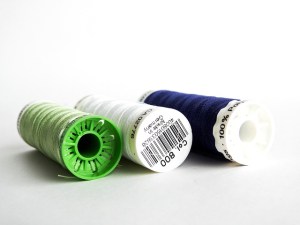
 To get started, you’ll need a sewing kit. I have one like
 I picked up a package of Denim Iron on patches at Joann’s- I used a 50% off coupon, so they were only $2.14 with tax! And I still have half a package left, so I can repair another pair of jeans too!
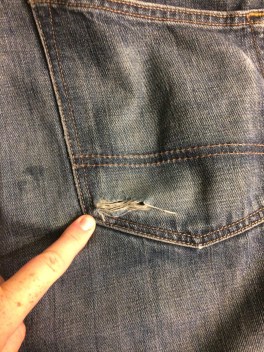 1-Find the hole, and make sure that the patch(es) are cut to the right size. You want to cover the hole completely, and the surrounding area, so the patch has some stable fabric to fuse to.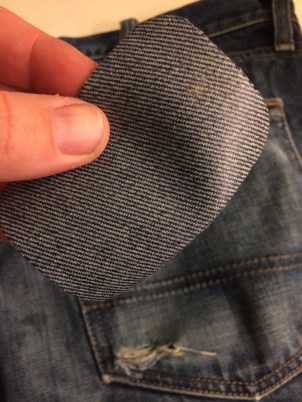


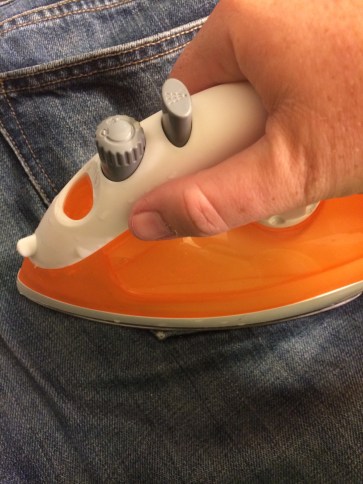 3-Once the clothing/patch has cooled, you can stitch around the edge to make it extra secure, however, in this case I did not. I would do that for the knees of kiddo pants or other high wear areas.
 Hewes Family Fun