If you read the fine print on coupons, it usually says a bunch of stuff that rivals legal documents.
 You’ve probably seen the following statements:
- Limit one coupon per purchase….
- Limit one coupon per transaction…
- Limit one coupon per purchase of products and quantities stated. Limit of 4 like coupons in same shopping trip…
- One coupon per person, per day…
- Limit one manufacturer and one Target/Store coupon per item…
- Limit of 4 identical coupons per household, per day…
UGH!!! That’s so confusing! How is anyone supposed to stockpile and save tons of money when there are so many restrictions?
Well, let’s clear that one up.
- Each item you are buying is a purchase. 3 widgets, 3 coupons for those widgets, 3 purchases. You don’t need to buy each widget separately, you can have them all rung up together.
- A transaction is your entire basket order. Everything you put onto the conveyor belt all totalled is your transaction. Some stores (not too many, check your stores coupon policy) allow you to break up your basket into separate transactions to use more coupons.
- Our third example comes from Proctor and Gamble (P&G) coupons. This means that you can only use four of the same coupons on four of the items stated on the coupon, in the sizes stated on the coupon in the same shopping trip. The term”shopping trip” is up for debate, but to me that means per time you visit the store. Some couponers argue that “shopping trip” is the same as transaction. I don’t chance it. I’ll just stick to four P&G coupons per store visit.
- The fourth example is super rare, generally seen on high value store coupons. It means exactly what is says. You may use one of those coupons per day. Your mom may use one of those coupons per day, your uncle, your cat, etc.
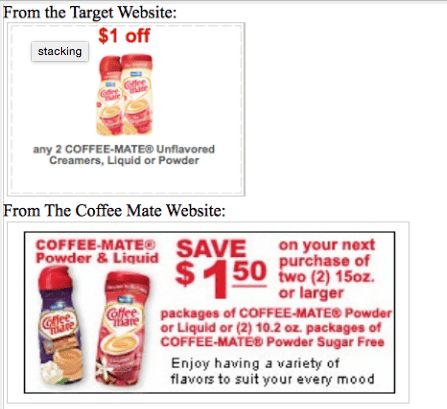
- Target and some other stores (Albertsons, CVS, Walgreens, and Vons) allow you to match up (or stack) a store coupon with a manufacturer coupon. An example is shown below with coffee creamer. Store coupons can be found on on the stores website or in store advertisement/circular that is available in the store. Target and Albertsons have store printable coupons available on their website, while Vons has store coupons that you can load onto your Vons card (these are sometimes called E-coupons or electronic coupons). CVS and Walgreens have sale flyers and coupon booklets in their stores and CVS has the “magic coupon machine” where you wave your CVS card under the reader, and it spits out coupons! Check your stores coupon policy to see if they have any further restrictions on how many stacked coupons you can use per transaction, which bring us to…
- This is taken directly from Target’s updated coupon policy. At Target (and some other stores), you may use 4 identical/like coupons per household, per day. So, at Target, you can stack 4 sets of coupons. 4 Target coupons and 4 manufacturer coupons for your 4 items for your household. That doesn’t mean you can’t come back the next day and do it again! I’ve done that before when a deal is super hot.

 Hewes Family Fun